
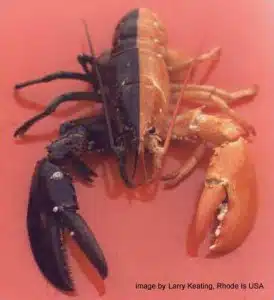
A team of Queensland researchers have discovered that lobsters, prawns and other crustaceans have evolved a unique way of making colours: making the complex patterns appreciated by biologists and connoisseurs of seafood.
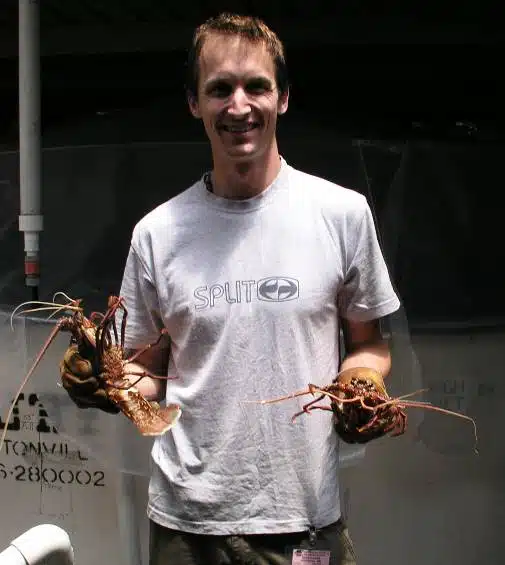
Dr Nick Wade during his PhD research on the western rock lobster, Panulirus cygnus. Photo credit: Nick Wade, UQ.
Their work will help with conservation, aquaculture and may even lead to a new food colourant. And all the colours come from just one molecule.
The colour of seafood is directly linked to its acceptability as food. Highly coloured lobsters and prawns attract a premium price. And for the crustaceans themselves, it’s a matter of survival.
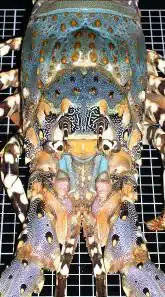
The intricate shell patterning and colouration of the tropical rock lobster, Panulirus ornatus. Photo credit: Nick Wade, UQ.
So, whether you are working in the world’s US$38-billion crustacean fisheries or part of the catch, the work of Dr Nick Wade and colleagues at the University of Queensland (UQ) and Australian Institute of Marine Science (AIMS) is significant. They have identified the underlying genetics that explains the way in which crustaceans produce their wide range of shell colours. Their research was published this week in the Journal of Molecular Biology and Evolution.
“This knowledge of how crustaceans produce and control colour helps us understand the genetic diversity and evolution that underpins this group of highly successful group of animals,” Nick says, “as well as benefit the future development and sustainability of the aquaculture industry.”
In order to be coloured, all crustaceans must consume the same small molecule known as a carotenoid. They occur widely in nature: in photosynthetic bacteria, algae and plants such as carrots and capsicums.
Crustaceans use the bright red carotenoid astaxanthin bound to a protein, called crustacyanin. This protein modifies the carotenoid wavelength to any other colour in the visible spectrum. “Apart from crustaceans, no other animals we analysed had the crustacyanin gene”, says Nick. “Therefore, we now know that crustaceans have evolved a unique way of using this simple carotenoid building block to produce all their colours”, he says.
“This protein is used only by crustaceans to create their intricate and diverse shell colour patterns”, says Nick, “providing protective camouflage or communication which, in turn, may have contributed to the success and diversification of their group”. But the coloured protein complex can be easily disrupted, as we see when we cook prawns, crabs or lobsters, and the original red carotenoid is released producing the colour we associate so strongly with cooked seafood.
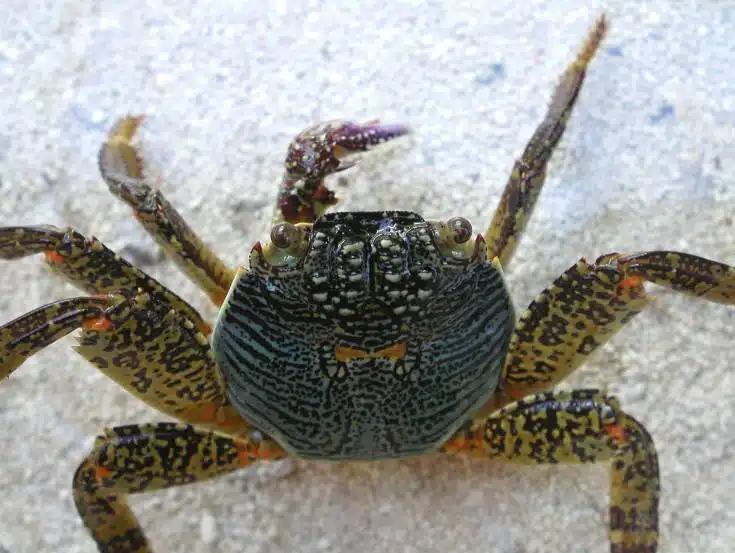
The intricate shell patterning and colouration of a Grapsid crab. Photo credit: Nick Wade, UQ.
When bound to protein, the normally fat soluble carotenoid also becomes strongly water soluble, providing a potential application for these compounds as natural food colourants. Other uses could include coloured heat or pH indicators.
Reference: Nick Wade, Alina Tollenaere, Mike Hall and Bernard Degnan, Evolution of a novel carotenoid binding protein responsible for crustacean shell color, Molecular Biology and Evolution, published August, 2009. This research was conducted as part of an Australian Research Council Linkage grant.
Contact Nick on +61 (438) 137 661, Nick.Wade@csiro.auNick Wade, now a researcher with the CSIRO Food Futures Flagship, is one of 15 early-career scientists presenting their research to the public for the first time thanks to Fresh Science, a national program sponsored by the Federal Government.
For Fresh Science contact: Sarah Brooker on 0413 332 489 and Niall Byrne on 0417 131 977 or niall@freshscience.org. For images and background visit www.freshscience.org
Header: A rare colour mutation in clawed lobsters demonstrates the importance of genetics in crustacean shell colour formation. Photo credit: Larry Keating (Rhode Island USA).
Creating Colour: Crustacean Style: background information
Have you ever been fascinated by the colour change we observe when we cook up some lovely seafood? Why that beautiful blue prawn or green crab turns a wonderful scarlet red colour when cooked, a colour we associate so strongly with healthy, tasty seafood?
Well, as it turns out, all these colours and the intricate shell colour patterns of crustacean shells are produced by one protein, one that is unique to this group of animals.
Colour in crustaceans is produced by the interaction of a carotenoid, called astaxanthin, with a protein known as crustacyanin.
More than 600 carotenoids are known in nature, and they split into two broad categories: the carotenes (oxygen free) and xanthophylls (containing oxygen).
In humans, carotenoids such as beta-carotene are a precursor to vitamin A, a pigment essential for good vision, and carotenoids can also act as antioxidants.
The colour of carotenoids ranges from pale yellow to bright orange and deep red and is directly linked to their structure.
Within the crustacyanin protein complex, astaxanthin gets twisted or distorted to produce a shift in its wavelength from red to any other colour in the visible spectrum.
Upon cooking, the complex is disrupted and the red astaxanthin molecule is released once again, changing the colour of the animal to the one we so strongly associate with seafood.
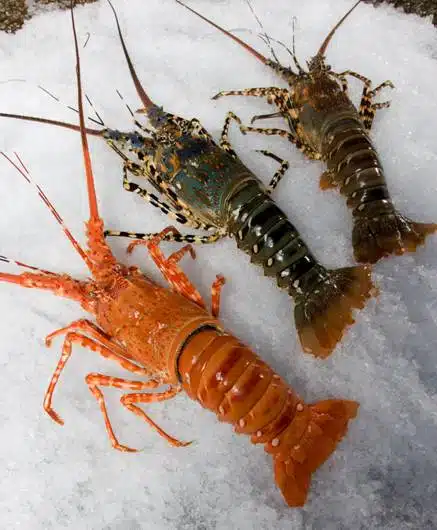
Natural colour of the tropical rock lobster, Panulirus ornatus, and the colour change when cooked due to the release of the red carotenoid from the crustacyanin protein. Photo credit: CSIRO Food Futures Flagship
Crustacyanin and the shell colour of lobsters has been the topic of scientific research for more than 100 years.
Previous research focused on extracting and purifying crustacyanin directly from lobster shells.
It had been established that crustacyanin was a 25 kDa protein with a number of distinct forms.
The 3-dimensional crystal structure of this protein has also been resolved.
Crystals of this protein were even formed in an experiment in space.
Two crustacyanin proteins are known to combine with 2 astaxanthin molecules to form the purple b-crustacyanin complex.
Indeed, the high molecular weight complex known as a-crustacyanin, which is blue, is composed of eight b-crustacyanin subunits.
Carotenoids are unable to be produced by most higher animals and thus form an important component of the crustacean diet.
Using a combination of molecular biology techniques and bioinformatics, the former University of Queensland PhD student and his colleagues searched for the presence of crustacyanin across a wide range of animals, identifying it in a only a subset of crustaceans.
The protein was only present in those animals that we would all easily recognise as crustaceans (crabs, lobsters, prawns etc).
This study identified the 2 genes encoding the two crustacyanin proteins in a range of Malacostracan crustacean representatives.
A total of 13 novel sequences were identified across 8 different crustacean species, and represent the first crustacyanin gene sequences identified.
Across other members of the animal kingdom, these genes could not be identified in targeted molecular genetic approaches or from searches of 13 currently sequenced genomes, including the distantly related insects or the water flea Daphnia, a more closely related crustacean.
This provides evidence of a gene duplication event in the early crustacean ancestor, and co-option of this duplicated gene into a new role in shell colouration.
The sequences identified revealed that the protein itself had evolved, over a long period of time, to form a specific subgroup within a much larger functionally diverse protein family: the lipocalins.
Analysis of the tissue beneath the hard exoskeleton showed that specific expression of the crustacyanin genes was responsible for the intricate shell patterns and range of colours we observe in crustacean shells.
As such, we have demonstrated that certain crustaceans have exclusively evolved the ability for crustacyanin to produce a full spectrum of colours using a simple single coloured carotenoid as the basic building block.
Our research demonstrates a strong genetic effect underlying crustacean colouration and reveals the genetic basis of its complexity.
The ability of crustaceans to modify their colour in this way has had a profound influence on the success of this group of animals throughout evolution.
In turn, these factors are known to have an effect on camouflage, predation, mate selection and communication in many crustaceans.
This research also has many applications for the Australian and worldwide aquaculture industry, as the value of the product is highly dependent on the colour.
In the future, research will focus on the ability to induce animals in aquaculture to become more colourful more quickly, reducing costs and boosting product value an
d acceptability.
Further uses include producing a natural series of water soluble food dyes that also deliver the beneficial health effects of astaxanthin, or colour indicators for heat or pH would also be possible.
Alternatively, if you ever imagined owning a purple polka-dot crab or lobster as a pet, then this might be the time to ask.

 Fresh Science is on hold for 2022. We will be back in 2023.
1,683 Comments
Gabriel36
13 September 2026 at 2:34 pmkoketochka555
sergio
13 September 2026 at 2:39 pmporn thai
greg
13 September 2026 at 2:51 pmcartoonpornvideos
lisa
13 September 2026 at 3:09 pmgay porn black
rick
13 September 2026 at 3:16 pmfake taxi full video
lena
13 September 2026 at 3:29 pmxnxxporn
ines
13 September 2026 at 3:39 pmreverse cowgirl anal
egor1981
13 September 2026 at 3:49 pmboys masturbating
free.Susan
13 September 2026 at 3:55 pmfemdom ass worship
Deepak56
13 September 2026 at 4:11 pm3d porn gif
Rafa
13 September 2026 at 4:45 pmuk porn tubes
traveler93
13 September 2026 at 4:59 pmgay big dick
supertariq
13 September 2026 at 5:07 pmshemale lesbian porn
kai74
13 September 2026 at 5:18 pmbig uncut cock
realDreamer
13 September 2026 at 5:32 pmanal dildo porn
dan10
13 September 2026 at 5:38 pmskinny xxx
vijay1999
13 September 2026 at 5:54 pmcuckold training
your_tom
13 September 2026 at 6:08 pmسکس کون
anton2022
13 September 2026 at 6:25 pmanna bailey porn
kaito5358
13 September 2026 at 6:40 pmسكس مراهقه
true.javier71
13 September 2026 at 6:49 pmerotica gif
megagreg
13 September 2026 at 7:00 pmangela white vr
andrea
13 September 2026 at 7:14 pmhentai naruto
true.caleb1985
13 September 2026 at 7:19 pmlads naked
rodrigo1998
13 September 2026 at 7:34 pm性爱视频
steve2012
13 September 2026 at 7:42 pmgay cum compilation
petr1978
13 September 2026 at 7:53 pmkonulu porn
happy_hao88
13 September 2026 at 8:10 pmdiaper hentai
henry
13 September 2026 at 8:31 pmbig cock gay
coder2015
13 September 2026 at 8:45 pmtop asian pornstars
hiro
13 September 2026 at 8:55 pmسكس اغراء
luckyTom7924
13 September 2026 at 9:08 pmbrianna beach mom comes first
jonas
13 September 2026 at 9:13 pmbest anal porn
best_khaled6861
13 September 2026 at 9:37 pmnaked tik tok
dailymaria
13 September 2026 at 9:48 pmgay fetish porn
jean.elsa
13 September 2026 at 9:52 pmanny walker porn
anjali
13 September 2026 at 9:58 pmdiaper girl porn
global.liam
13 September 2026 at 10:01 pmfree porn ebony
superjane
13 September 2026 at 10:05 pmstraight lads naked
stefano
13 September 2026 at 10:10 pmcockold porn
rafa.diane
13 September 2026 at 10:16 pmbig tits vr
Sora32
13 September 2026 at 10:19 pmgayfuck
maja
13 September 2026 at 10:25 pmvr orgy
smart_niklas1999
13 September 2026 at 10:28 pmhuge tits onlyfans
aaron
13 September 2026 at 10:34 pmnude gymnastics
the_felipe
13 September 2026 at 10:46 pmteen porn vids
luke
13 September 2026 at 10:53 pmporn fun
Tara25
13 September 2026 at 11:08 pmskylar mae fucked
happytrader1992
13 September 2026 at 11:17 pmdetroit become human porn
true.gamer
13 September 2026 at 11:27 pmcandy samira porn